Antibiotics

Cephalosporins

Background

In the US, 1.3% to 1.7% of the total population reports a cephalosporin allergy whereas 0.5% of pediatric patients report a cephalosporin allergy (Chow, Brunner, and Khan 2024; Khan et al. 2019)

Most reactions to cephalosporins are immediate (74.7%)–characterized by urticaria and/or angioedema–as opposed to delayed–typically non-severe maculopapular exanthem (25.3%).

The chemical structure of cephalosporins is a four membered ring fused with a six membered dihydrothiazine ring with R1 and R2 side chains.

The R1 side chain is the major component responsible for the cross-reactivity with penicillins and cephalosporins. Tolerance to cephalosporins can usually but always be predicted on the basis of similarities or differences in R1 side chains.

R2 side is less studied but may have a role. There is some evidence that suggests that the opening of the cephalosporin beta-lactam ring destroys the R2 side chain.

Trick question! None!

Ceftazadime.

Cefaclor accounts for up to 80% of serum sickness-like reactions.

Skin Testing

Lack of commercial products and metabolites for skin testing.

Immediate Index agents: cephalexin (55.5%), ceftriaxone (24.9%), and cefazolin (17.5%)

8.9% of pateints had positive skin tests (cefazolin 50% positives)

Time since index reaction, OR 0.71 (95% CI 0.57 - 0.90) for positive skin test. (Stone, Trubiano, and Phillips 2021)

Oral Challenge

100% NPV if reaction > 5 years, isolated urticaria, benign MPE, isolated GI symptoms or other non-allergic and orally administere vs 98.5% NPV (95% CI 95.8%-99.7%) if include IV and PO administered. (Stone, Trubiano, and Phillips 2021)

Cephalexin 250 mg oral challenge with 1.5 hour observation. (Koo et al. 2022)

Fluoroquinolones

Macrolides

Background

Macrolides are defined by a large lactone ring, which varies from 12 to 16 carbons, with 1 or more attached sugar chains. Eyrthromycin and clarithromycin have 14 carbons in their lactone rings while azithromycin has 15.

As 50S ribosomal subunit inhibitors, macrolides exert their bacteriostatic effect by inhibiting protein synthesis.

While not extensively studied, macrolide antibiotics with a different number of carbon atoms in their lactone ring are tolerated by most patients. Macrolide antibiotics are also unlikely to cross-react with macrolide immunosuppressants (e.g., tacrolimus, sirolimus).

Clarithyromycin is used as part of combination treatment for H. pylori. Azithromycin is a part of the first-line combination therapy for Mycobacterium avium complex.

  1. GI side effects: Because macrolides are also agonists for the motilin receptor–stimulating gastric and small intestine motility–they can cause nausea, vomiting, diarrhea, and abdmoninal cramping. Accordingly, erythromycin can be used as a treatment for gastroparesis.

  2. Sensorineural ototoxicity (usually transient).

  3. QT interval prolongation.

Skin Testing

Skin testing for macrolide immediate hypersensitivity has not been shown to be reliable.

Oral Challenge

For patients with a history of immediate hypersensitivity reaction to a macrolide, graded azithromycin challenge can be performed, starting with azithromycin 25 mg followed by 1 hour observation then 250 mg followed by 2 hour observation.

For patients with a history of non-severe delayed hypersensitivity reaction to a macrolide, single dose azithromycin 250 mg challenge with 2 hour observation can be performed. Patients should be instructed to report any other delayed symptoms, which may occur up to 24 to 48 hours after the challenge dose.

Penicillins

Background

Approximately 10% of the US population reports an allergy to penicillin.

Less than 5% of these reported penicillin allergies are clinically significant immediate or delayed-immune mediated drug reactions.

Over 95% of patients who do not have a history of serious penicillin allergy are actually tolerant because (1) the most common reported reaction is a benign delayed rash (type IV hypersensitivity reaction) which may or may not recur with subsequent penicillin exposure; (2) IgE-mediated penicillin allergy wanes over time, with 80% of patients becoming tolerant after a decade since their index reaction; and (3) the index reaction may have rather been an intolerance or caused by the underlying infection being treated at the time. (Shenoy et al. 2019)

Individuals who report a penicillin allergy label are more likely to receive broad-spectrum antibiotics that increase the risk for antimicrobial resistance, including methicillin-resistant Staphylococcus aureus and vancomycin-resistant Enterococcus. In addition, broad-spectrum antibiotics also increase the risk of developing Clostridium difficile infection.

Receipt of non-beta-lactam perioperative prophylaxis has been associated with an increased risk of surgical site infections.

Epstein-Barr virus. (Chovel-Sella et al. 2013)

About 0.5% to 2.0%

Potentially due to the decrease in use of parenteral penicillins in the outpatient setting, where most antibiotic use occurs.

(Macy et al. 2009)

Skin Testing

The NPV of penicillin skin testing is > 95% when performed with only benzylpenicilloyl polylysine plus penicillin G or with benzylpenicilloyl polylysine plus full panel of minor derterminants.

Reagent Description
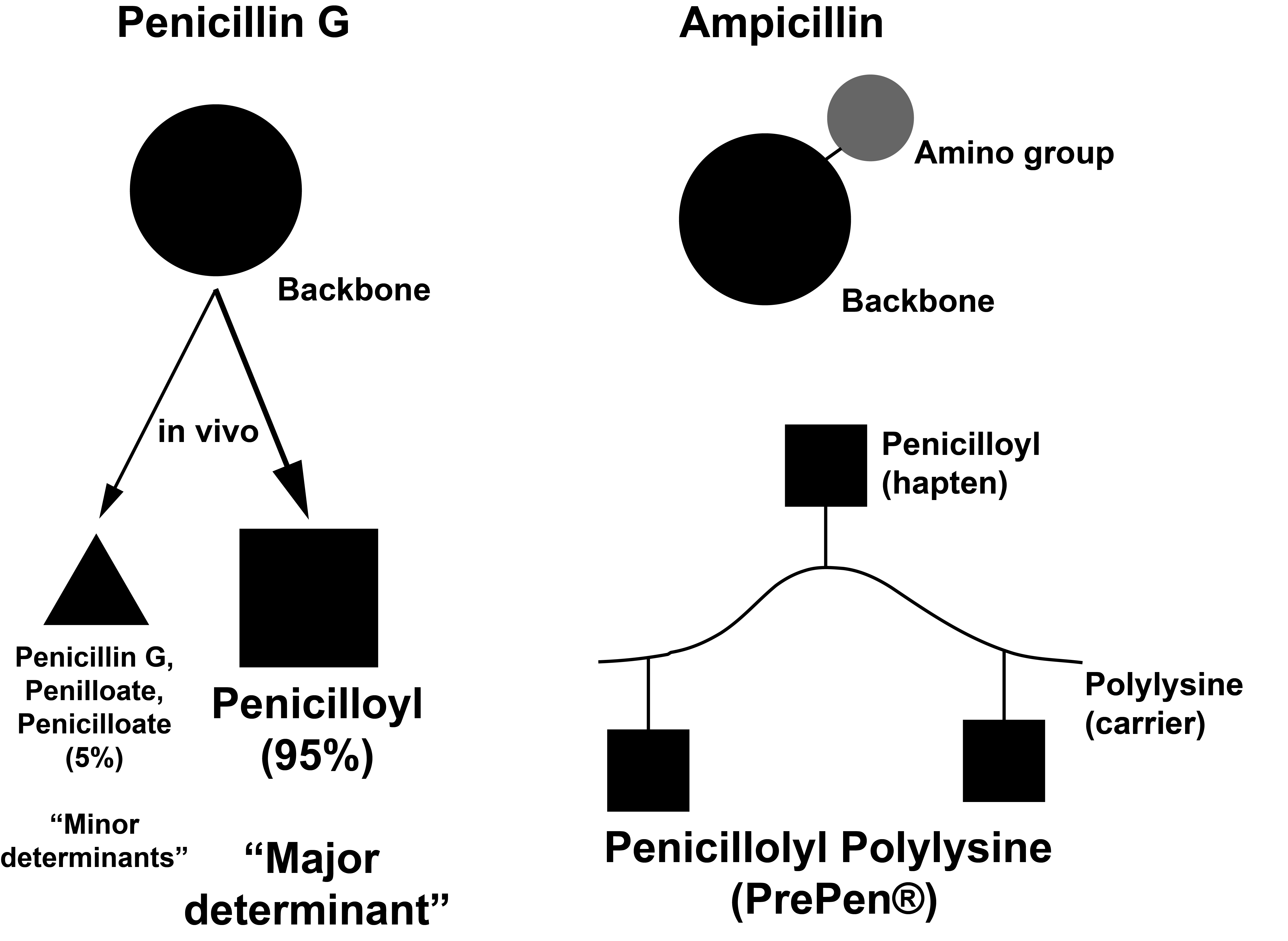
Penicilloyl polylysine (PrePen®)
  • Penicilloyl is the Major antigenic determinant (what 95% of penicillin degrades into)

  • PrePen is penicilloyl complexed with polylysine to constitute a multivalent skin test reagent.

  • Polylysine acts like the carrier for the penicilloyl hapten in vivo.

Minor derterminant mixture (MDM)
  • Penicillin G itself, penicilloate, and penilloate

  • Not commercially available expect in South America and Spain

Penicillin G
  • Also called benzylpenicillin
Ampicillin
  • Differs only from penicillin G by the presence of an amino group (-NH2)
Note

Selective IgE-mediated reactions to aminopenicillins are rare in North America (e.g. 3-5% in the United States) versus 25-50% of skin test positive patients in Europe.

Figure 1: Penicillin G, ampicillin, and penicilloyl polylysine

The polylysine carrier has ~40 lysine repeats.

Oral Penicillin = Penicillin VK IM/IV Penicillin = Penicillin G Amino group = -NH3

Aminopenicillins = Amoxicillin, Ampicillin Aminocephalosporins = Cephalexin, Cefadroxil, Cefprozil and Cefaclor

References:

Chapter 77 Middleton’s Drug Allergy

Sulfa Antibiotics

Background

The reported global prevalence of sulfa antibiotic allergy is 3% to 6%. The prevalence is higher is individuals with hematological malignancies (12-40%) and HIV (30-70%) (Serrano-Arias et al. 2024).

Sulfa antibiotics–also called sulfonylarylamines–are characterized by the presence of a sulfonamide functional group with two side chains, arylamine (aromatic amine) and an aromatic heterocyclic ring (Serrano-Arias et al. 2024).

No, they do not cross-react because non-antibiotic sulfonamides lack the same side chains as sulfa antibiotics–aryalmine and aromatic heterocyclic ring (Serrano-Arias et al. 2024).

Trimethoprim-sulfamethoxazole is the preferred prophylaxis for Pneumocystis jirovecii pneumonia (PJP) because of its greater evidence of efficacy and lower cost compared to alternative prophylaxis, such as atovaquone, dapsone, and aerosolized pentamidine (Maertens et al. 2016).

Further, compared to alternative PJP prophylaxis, trimethoprim-sulfamethoxazole may also prevent other breakthrough infections such as Nocardia, Toxoplasma, Streptococcus pneumoniae, and Haemophilus species.

A Cochrane review on the efficacy of trimethoprim-sulfamethoxazole for PJP prevention in non-HIV immunocompromised patients found the number needed to treat to prevent one case of PJP is 19 (Stern et al. 2014).

When considering Pneumocystis jirovecii pneumonia prophylaxis, the two main patient populations to consider are non-HIV immunocompromised and HIV immunocompromised individuals.

HIV immunocompromised:

  • CD4+ T cell count < 200 cells/µL

Non-HIV immunocompromised:

  • Solid organ transplant

  • Bone marrow transplant

  • Prednisone ≥ 20 mg (or equivalent) for more than one month

The first cases of Pneumocystis jirovecii pneumonia were described in malnourished children in orphanages in Europe during World War II. When initially described, it was referred to as “interstitial plasma cell pneumonia (Morris et al. 2004).

Pneumocystis jirovecii is a ubiquitous fungus with infection commonly occurring at young age, with near universal positivity to Pneumocystis by two years of age (Vargas et al. 2001). In immunocompetent individuals, primary infection is largely asymptomatic. In addition, colonization with Pneumocystis jirovecii occurs in more than 50% of the general adult population and is assumed to be due to re-infection (i.e. person-to-person transmission, environmental re-exposures) rather than reactivation (Gigliotti and Wright 2012).

DNA sequencing improved our understanding of Pneumocystis and its different species that are associated with various host organisms. Therefore, Pneumocystis jirovecii describes the species that infects humans while Pneumocystis carinii describes the species that infects rats (Stringer et al. 2002).

Hyper-immunoglobulin M syndromes—the X-linked recessive version caused by defects in CD40L (expressed on the surface of T cells to induce antibody isotype switching in B cells)–is associated with a notably increased risk of Pneumocystis jirovecii pneumonia (Davies and Thrasher 2010).

Co-trimoxazole is the British Approved Name (BAN) for trimethoprim-sulfamethoxazole. BANs are assigned for both single-drug and combination preparations. The prefix of “co-” is used for denote combination drugs like trimethoprim and sulfamethoxazole. For example, the combination of amoxicillin and clavulanic acid has the BAN “co-amoxiclav.”

Figure 2: Sulfonamides and sulfone structures

Vancomycin